
 202 Products in 18 Families
 Packaging Built Around the Buyer
 From Brief to Approved Sample
 Cosmetic Packaging Buyer Guide
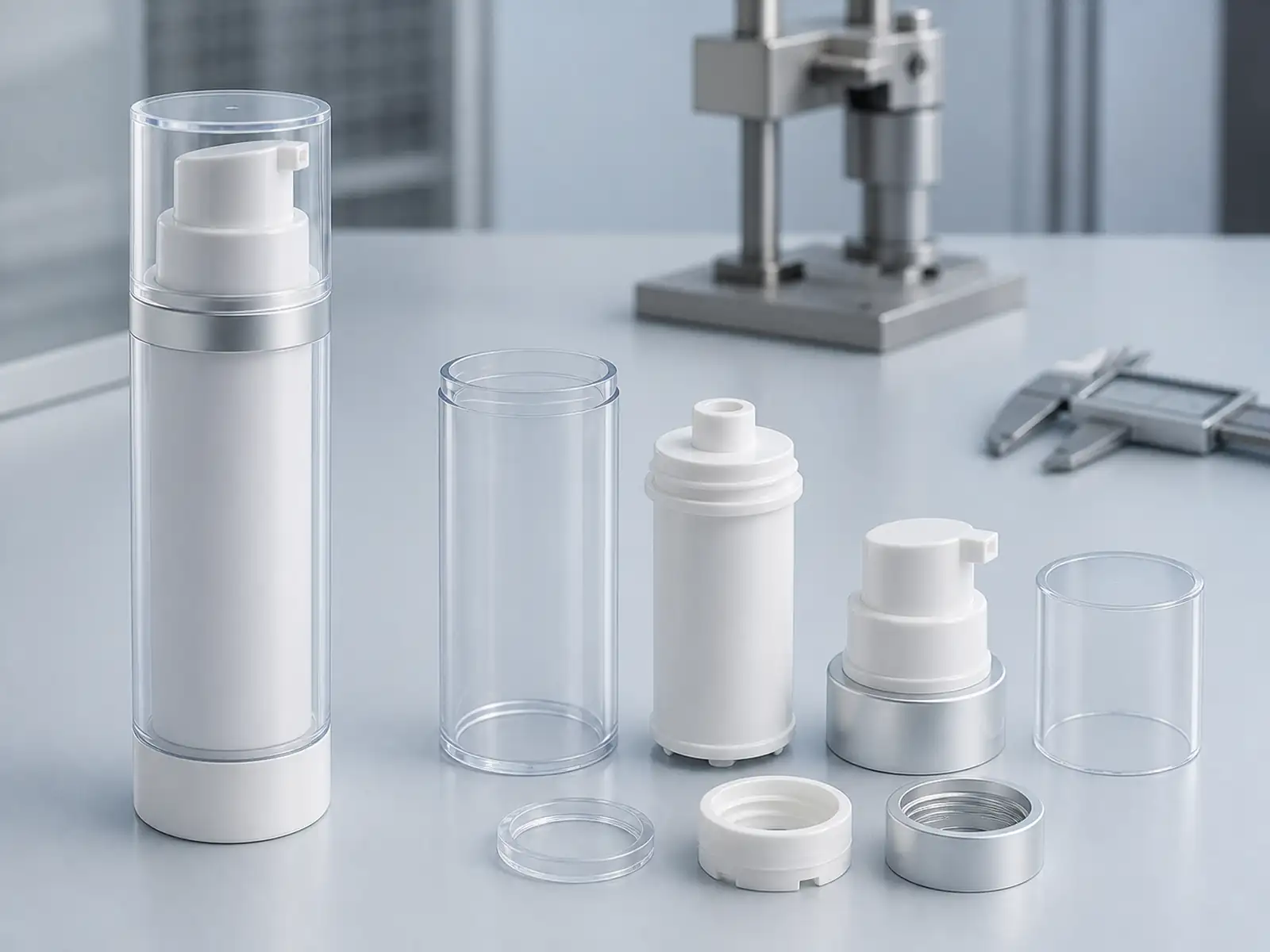
Selecting an airless bottle is an architecture decision; approving one is an evidence decision. The assembled pack must draw product, deliver a controlled amount, move its piston or bag as designed, protect the formula within the intended scope and continue working as the product level falls. A sample that dispenses five times on a desk proves very little about storage, repeated use or the last portion of the fill.
An effective validation plan follows the product through its use cycle. It defines the exact components and fill process, measures initial priming and steady-state delivery, observes behavior at different fill levels, quantifies retained product using an agreed method, and investigates failures while separating formula, component and process causes. The result is a project record with a clear scope, rather than a broad “airless” or “zero waste” label.
Establish the Airless Architecture Under Review
“Airless” covers more than one mechanical design. Some packs use a piston that rises as product is dispensed. Others use a collapsible pouch or bag within a rigid outer container. Pumps may be integrated, crimped, snapped or threaded. Refill concepts can add interfaces that a single-use pack does not have.
The validation record should identify:
- outer bottle or shell material and drawing;
- product chamber, piston, pouch or bag construction;
- pump, actuator, valve and spring configuration;
- sealing parts and all formula-contact materials;
- nominal and actual fill volume;
- fill opening and bottom-closure arrangement where relevant;
- vent path and any transport lock;
- assembly method and component revisions;
- decoration or secondary parts that could affect movement or venting.
Use the exact BOM and approved sample as the package identity. A family name is too broad because two packs with the same exterior can contain different pumps, pistons, seals or contact materials.
Translate the Product Experience Into Testable Requirements
The brand should decide what a satisfactory pack must do. Requirements may concern the number of strokes before first product, dose per actuation, variation during use, acceptable sputtering near the end, ability to dispense in different orientations, actuator force, lock performance and product remaining when normal use ends.
These outcomes are influenced by formula rheology, temperature, entrained air, fill method and consumer actuation. They should be written with conditions attached. “Dose of X” without formula density, temperature, stroke method and measurement sequence is incomplete. “Low residual” without defining the normal-use endpoint and weighing method is not reproducible.
Separate mandatory requirements from preferences. A soft actuator feel may matter to marketing, while reliable valve closure remains a functional need. Conversely, a system that passes a broad leakage check may still provide an unacceptable user experience. Both types of criteria belong in the approval plan, but they need different evidence.
Control Filling Before Testing the Pump
Air trapped during filling can look like poor priming or dose inconsistency. Incorrect bottom closure, piston position or fill level can prevent normal movement. Before judging the package, document the fill process.
Record formula temperature and viscosity, filling equipment, nozzle position, fill rate, target weight, deaeration or settling step, headspace where applicable, and the interval between filling and testing. For bottom-fill piston systems, document piston and base-plug assembly. For pouch systems, record how the chamber is evacuated or prepared. Inspect vents for obstruction.
Use realistic pilot conditions. Hand filling can support screening, but differences from production equipment should be listed as deviations. A line trial may be needed when filling speed, nozzle behavior or component handling could influence trapped air and seal quality.
Retain fill-weight records for every test unit. If the pack later shows high residual or an early stop, the investigation needs to distinguish true retained product from initial underfill or loss during preparation.
Define Priming as a Pass/Fail Event and a Distribution
Priming is the transition from an unprimed system to delivery of an acceptable product dose. Decide what counts as acceptable: the first visible product, a continuous discharge, or a dose within the steady-state range. For consumer experience, the third definition is often more informative, but the project should choose explicitly.
Test multiple units and record every result. Report the distribution, not only the average. One unit requiring many more strokes may reveal an intermittent seal, vent or fill problem that an average conceals. Note whether the actuator was fully depressed, the package orientation, rest time after filling and formula temperature.
ASTM F02.30 lists D3890 as a practice for the number of strokes to prime a mechanical pump dispenser. It can provide a controlled foundation, while the airless project still defines specimen preparation, acceptable discharge and its own limit. Confirm the edition used in the controlled test instruction.
Repeat priming after relevant storage or transport only when the system has lost prime or when restart is a defined risk. Report initial priming and restart after consumer non-use as separate results.
Measure Dose Through the Use Curve
Steady-state output near the beginning of a pack is not the entire performance story. Measure delivery at stages that represent the product life: after priming, during the upper fill range, around the middle and near the expected endpoint. The exact checkpoints can be based on cumulative strokes, dispensed mass or piston position, but must be consistent across specimens.
Collect complete strokes at a controlled rate. Weighing product can provide practical output data; converting to volume requires the formula’s verified density at the test temperature. Record individual strokes or small blocks so trends are visible. Large combined collections can hide alternation, sputtering and gradual decline.
Review mean dose, variation within a unit and variation among units. Look for drift correlated with fill level or storage. Observe pattern or ribbon shape if the product’s application depends on it. Note partial returns, actuator sticking, air shots and delayed refill of the pump chamber.
ASTM F02.30 lists D4336 for determination of output per stroke and D6534 for peak force to actuate a mechanical pump dispenser. These method titles identify relevant measurements, not universal pass limits. The brand should set experience and dose requirements using the intended formula and actuator.
Observe Piston, Pouch and Vent Behavior
For a piston system, track whether the piston rises evenly and remains aligned. Tilting, sticking, bypass or sudden jumps may affect dose and residuals. A transparent development sample can make movement visible, but a production decoration or opaque wall may change inspection access. Where the internal motion is hidden, define an alternative production check.
For a bag or pouch system, observe collapse uniformity, creasing, delamination, loss of connection and trapped pockets. The rigid outer shell needs an unobstructed air path where the design requires venting, so decoration, labels and overmolding must leave that path clear.
Orientation testing should reflect intended claims. Some airless systems are designed to dispense at varied angles, but that capability must be demonstrated for the selected formula and fill state. Avoid promoting “360-degree dispensing” merely because one sample worked upside down once.
Define Residual Product Before Measuring It
Residual-product claims are often incomparable because teams use different endpoints and calculations. Decide when the package is considered empty. Is it after the first air shot, after a defined number of failed full strokes, after output falls below an agreed level, or after a consumer-use simulation? Each choice can produce a different result.
Then define the measurement basis. A mass-balance approach can start with the net filled product mass and subtract the mass dispensed or recover the remaining product through a controlled destructive method. Account for product left on test tools, external surfaces and removed components. Tare weights and scale resolution should be recorded.
Possible calculations include residual mass, dispensed mass as a percentage of verified fill mass, or residual as a percentage of net contents. State the formula and units. A single measured sample supports only that observation; any evacuation-rate conclusion also needs specimen-level results and variability.
Residuals also need interpretation. Product may remain as a uniform coating beyond the mechanism’s reach, in a pocket caused by piston or pouch behavior, inside the pump chamber, or because testing stopped early. Photograph and locate the residue. The corrective path depends on where it is retained.
Include Storage and Formula-System Stability
Mechanical function can change as components and formula remain in contact. A validation program may include ambient storage, elevated or reduced temperature, cycling, orientation and light exposure as justified by the product. Let the scientific plan and intended distribution determine the conditions instead of assembling arbitrary extremes.
At each checkpoint, inspect product appearance, odor where appropriate, package deformation, seal condition, leakage, actuator behavior, dose, force, restart and internal movement. Compare with formula controls in compatible laboratory containers when the study design requires it. A control helps distinguish package interaction from formula aging unrelated to the pack.
ASTM F02.30 lists practices addressing compatibility of mechanical dispenser components and functional or storage stability. A current published method can support study design, but final cosmetic safety, shelf life and market compliance remain with the responsible finished-product parties.
Simulate Repeated Consumer Use
Consumer actuation naturally varies in pace and force. A controlled cycling test is still useful because it can expose wear, valve fatigue, actuator return problems and dose drift. Define stroke count or dispensed mass, rate, rest periods and inspection checkpoints. Use full strokes unless partial actuation is an intentional scenario.
Consider contamination around the actuator, product drying at the outlet, cap replacement, accidental lock engagement and handling with wet hands. These observations can inform instructions and design; measured functional evidence remains the basis for approval, with informal user comments providing context.
For refillable or replaceable-cartridge systems, cycling must include the connection and replacement process. A passing first fill establishes initial function, while reuse durability and hygienic suitability require their own evidence.
Investigate Failure Without Destroying the Clues
When a unit fails, pause further pumping and disassembly long enough to preserve the clues. Record specimen ID, fill stage, orientation, last successful dose, symptom and environment. Photograph piston or pouch position, vent, closure and outlet. Weigh the unit if residual analysis may be needed.
Classify the symptom:
- no prime;
- prime achieved but dose unstable;
- dose declines at a particular fill level;
- actuator fails to return;
- piston or pouch stalls or moves unevenly;
- air enters the discharge;
- leakage or product bypass occurs;
- lock or base component moves;
- unacceptable remaining product at endpoint.
Then check test setup and fill records, compare a control, inspect assembly and change one factor at a time. If a replacement pump solves the symptom, confirm whether the root cause was pump variation, assembly or an interaction with the original chamber. Repeat the relevant storage or cycling stage because a fresh immediate test covers only the immediate response.
Connect Acceptance to Change Control
The approval package should include the BOM, drawings, formula/test-fluid identity, fill instruction, specimen matrix, raw data, images, deviations and signed disposition by authorized project roles. Physical reference samples should be retained where feasible.
Identify changes that trigger review: pump or valve revision, piston resin, pouch laminate, gasket, lubricant, spring, dip path, vent geometry, bottle resin, decoration around a vent, filling method or formula. A supplier’s claim that a replacement is equivalent should be supported by an equivalence review and, when risk justifies it, focused revalidation.
Production controls should be realistic. The factory or filling partner may be able to check fill weight, assembly, appearance and a limited functional sample, while full storage validation remains a periodic or change-triggered activity. Separate incoming, in-process, release and long-term evidence so no one assumes a brief line check replaces the approval study.
Airless Validation Brief: Minimum Inputs
Before samples enter testing, confirm:
- exact package architecture, BOM and drawings;
- intended formula, density, viscosity and temperature range;
- filling, deaeration and assembly process;
- priming success definition;
- output method, checkpoints and acceptance approach;
- actuator-force and orientation requirements;
- piston, pouch and vent observations;
- residual endpoint, measurement formula and scale capability;
- storage, restart and cycling conditions;
- control formula/package, specimen IDs and lot coverage;
- failure handling, deviation and corrective-action rules;
- change-notification and revalidation triggers.
An airless package is ready for approval when the team can trace its performance to a defined assembly, formula, process and test boundary. The goal is reproducible evidence that supports the intended product experience and clearly marks what remains unproven.
If your airless configuration and formula requirements are defined, request a project-specific validation-scope review. Any proposed test plan should be confirmed against actual samples and the responsible brand’s acceptance criteria.