
 202 Products in 18 Families
 Packaging Built Around the Buyer
 From Brief to Approved Sample
 Cosmetic Packaging Buyer Guide
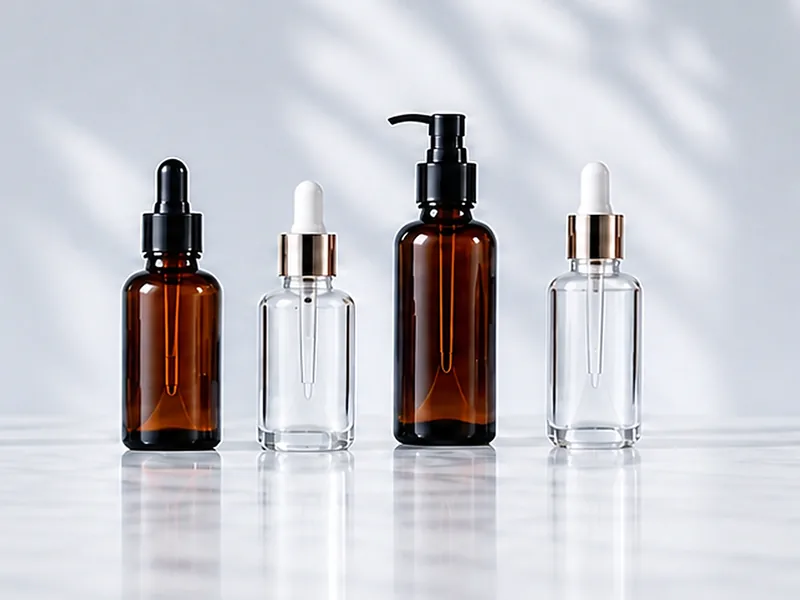
Two droppers sold under the same nominal size can deliver different results. Pipette length may be measured from a different datum; the bulb may recover at a different rate; the wiper may remove more product; or the collar may seat differently on the bottle finish. A useful RFQ describes the complete assembly and separates known dimensions from behavior that still needs to be demonstrated with project samples.
At minimum, provide a controlled bottle drawing, an identified closure/dropper build, a formula-risk brief, the intended dose or application behavior, the pipette-length datum, the desired tip-to-base relationship, wiper requirements, sample instructions, and approval evidence. Treat “1 ml dropper” or “standard 18 mm dropper” as a commercial description until the measurement method and mating package are defined.
Map the complete fluid path
Start by drawing the product-contact path from bottle to consumer. Depending on the system, the formula may contact the bottle, pipette, bulb or an internal bulb interface, collar insert, wiper, gasket, adhesive, coating, colorant, and other parts. Ask for a component and contact-material summary at a level the formula owner can review. The visible glass bottle and rubber-like bulb do not describe the entire system.
This map also clarifies ownership. A bottle source may not manufacture the bulb or pipette. A packaging integrator may coordinate specialist components. The RFQ should identify which party controls the assembled specification, which documents are available for each component, and who is notified if a material or source changes. This avoids treating a mixed supply chain as one undefined “dropper supplier.”
Formula disclosure should be risk-based. When a full formula cannot be shared, provide the product category, carrier system, viscosity or flow information with method and temperature where available, oil/solvent/alcohol concerns, fragrance or essential-oil load where relevant, pH if permitted, particulates, and known material sensitivities. This is not a compatibility approval; it helps the parties select candidates and design the final assessment.
Bottle finish and collar: names are not drawings
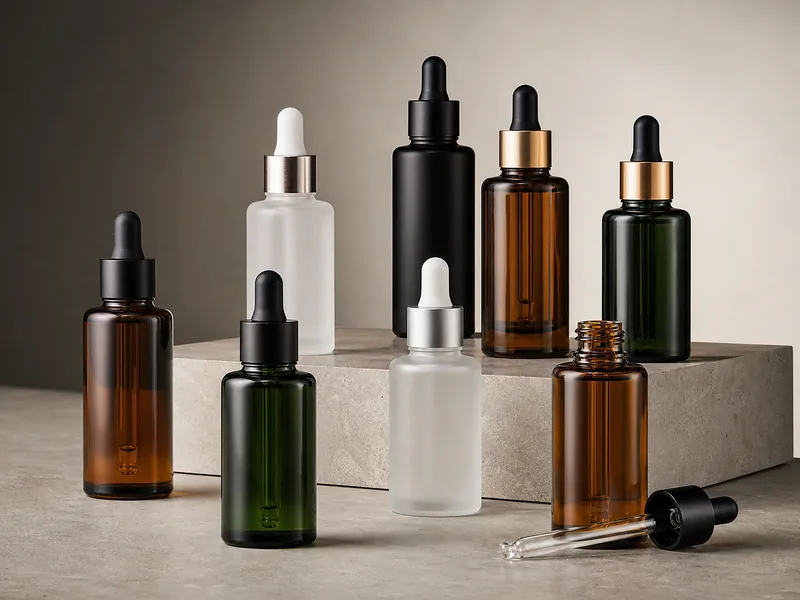
The bottle and collar need controlled geometry. Provide the bottle drawing revision, neck finish details, sealing surface, neck height, thread profile or other closure interface, and any tamper-evident or overcap requirement. A physical bottle sample should accompany the drawing during mating work, but one sample cannot define production tolerance.
Ask the dropper source to provide its mating drawing and to identify critical dimensions for thread engagement, sealing, pipette position, bulb clearance, and appearance. If the collar is aluminum, plastic with a metal shell, or another multi-part construction, record the stack because shell movement, crimping, adhesive, or insert geometry may affect assembly. Decoration can change friction or dimensions; a decorated approval sample should therefore be distinguished from an undecorated engineering sample.
Define how the closure is applied and inspected. Hand tightening may be adequate for screening but not for production release. The filler should review application equipment, torque or other application controls, cap height, levelness, and any risk of cross-threading. There is no universal torque value in this draft. The acceptable window depends on the actual closure, bottle finish, seal, application process, and performance evidence.
Pipette length: write the datum before the dimension
Pipette length is commonly misunderstood because different parties measure from different points. State whether length is measured from the underside of a gasket, a collar datum, the top of the closure, or the pipette’s connection point. Include a sectional drawing. Define pipette outside and inside dimensions if controlled, material, tip shape, wall characteristics where relevant, and retention method.
The target end position must consider the assembled closure stack and internal base profile. A pipette that appears correct beside an empty bottle may touch the base after assembly, sit against a push-up, or finish too high above the lowest product zone. Contact can chip glass in a poorly controlled configuration, obstruct the opening, create an unpleasant sound, or influence dose. Excessive clearance can increase inaccessible residue. The target is a project decision supported by drawing stack-up and samples, not “as long as possible.”
Check length under representative tolerances rather than only nominal dimensions. Bottle height, neck position, closure seating, gasket compression, pipette length, and tip geometry contribute to the stack. Ask which tolerances the supplier controls and how assembled clearance will be verified. Record whether the sample pipette was manually cut; production cutting can introduce a different distribution.
Bulb behavior is more than softness
The bulb is the user interface and part of the pumping mechanism. Its material, wall geometry, internal connection, recovery, compression force, and response after contact with formula can influence filling and delivery. “Soft” is a subjective description. A useful project brief instead describes the desired gesture: full squeeze before insertion, squeeze while immersed, controlled partial compression, or another intended method.
Evaluate recovery after repeated cycles and after conditioning. A bulb that returns slowly may reduce refill between uses; one that feels acceptable dry may behave differently when the internal path is wetted. Color, coating, and decorative finishes can alter feel or conceal surface change. The formula owner should include the bulb and any internal contact interfaces in its compatibility plan.
Do not describe a bulb material as universally resistant. Supplier declarations should state the component and scope. Project testing should state formula or surrogate, temperature, duration, orientation, sample count, observations, and acceptance criteria. If the bulb is not intended to contact formula during correct use, evaluate reasonably foreseeable contact and leakage paths rather than assuming isolation.
Wipers and inserts change both dose and cleanliness
A wiper or neck insert can remove product from the outside of the pipette, influence the amount retained, center the tube, reduce drips at the opening, or serve another mechanical function. It also adds material and dimensional interfaces. Specify whether a wiper is required, how it is retained, what pipette diameter it mates with, and whether it is installed before or after filling.
The interaction between wiper opening and pipette outside diameter deserves sample verification. Too much interference may increase withdrawal force, scrape coatings, dislodge the insert, or remove more product than intended. Too little may leave the tube messy or fail to control product at the opening. Formula viscosity, surface tension, and particles can change the result. A catalog pairing is a starting point, not final evidence.
Ask the filler to review insert installation, presence detection, seating, and line handling. A wiper forgotten or installed incorrectly can change dose and leakage behavior while the exterior package still looks normal. The BOM and inspection plan should therefore identify it as a controlled component.
Define “dose” before asking for a number
A dropper can be assessed by mass or volume drawn into the pipette, delivered from it, number or mass of drops under a defined procedure, or a marked graduation if the package legitimately uses one. These are different measurements. Decide which corresponds to the consumer instruction and product use. A supplier’s “nominal 1 ml” may describe pipette capacity, a full bulb cycle, or a commercial family name rather than delivered dose.
For an evaluation method, state bulb conditioning, immersion depth, bottle fill level, compression and release method, dwell time, withdrawal speed, wiper interaction, pipette angle, delivery method, number of cycles, liquid, temperature, density if converting mass and volume, and how partial or failed fills are handled. Human technique can dominate the result, so use a fixture or controlled operator instruction when repeatability matters.
Measure more than the average. Review unit-to-unit and cycle-to-cycle variation, failed pickup, bubbles, incomplete delivery, drops remaining on the tip, and changes as fill level falls. If a marked dose is connected to a regulated or therapeutic instruction, specialist regulatory and metrology review is required; this procurement guide does not qualify the package for that use.
Tip geometry and application behavior
Straight, rounded, angled, narrow, or specially formed tips can change drop formation, placement, and residue. The correct choice depends on whether the product is deposited on a fingertip, directly on skin where allowed by product instructions, on a scalp, into another container, or used in a different controlled way. Avoid contamination-prone claims or instructions that have not been reviewed by the finished-product responsible party.
Observe stream versus drop behavior, trailing, external wetting, contact with the wiper, and product left around the bottle opening. Thick or stringy formulas may not form discrete drops. Volatile or low-surface-tension products may reveal leakage or drip behavior that a water demonstration misses. Keep photographs and videos only as supporting observations; record the configuration and conditions so they are interpretable.
If the pipette has printed graduations, color bands, or decoration, verify their location, adhesion, readability, and formula-contact status under the intended use. Do not add dosage markings merely because a supplier can print them. Claims and instructions must match the product’s regulatory route and evidence.
Sample sequence for a dropper project
Use four gates. Gate one is document and dimensional screening: drawings, component identity, contact materials, closure fit, pipette datum, wiper geometry, and BOM. Gate two is dry and surrogate-liquid function: assembly, pickup, delivery, bulb recovery, wiper behavior, leakage, and gross handling. Gate three is project-formula work defined by the formula owner: compatibility, storage, cycling, dose behavior, and appearance. Gate four is final configuration: filling-line trial, closure application, coding, secondary packaging, and distribution evaluation.
Samples must be labeled by exact build. A clear bulb sample cannot silently become a black decorated bulb in production. A hand-cut glass pipette cannot stand in for an unverified production length. When a sample is made by a prototype process, note what it can and cannot approve.
Agree acceptance criteria before formal testing. If the team does not yet know the right limit, conduct an exploratory study and record it as such. Do not retroactively label the best candidate “pass” without a decision basis.
RFQ table for comparable bids
| Topic | Required input | Supplier response |
|---|---|---|
| Bottle | Code, drawing revision, material, capacity/fill | Mating confirmation, drawing deviations, sample need |
| Closure | Finish/interface, seal, application route | Collar build, gasket/insert, application guidance |
| Pipette | Datum, target clearance, material, tip | Drawing, tolerance, retention, production cutting route |
| Bulb | Desired gesture, color/finish, contact concerns | Material/build declaration, recovery sample route |
| Wiper | Required function and filling sequence | Opening/interface, retention, installation requirements |
| Delivery | Desired use behavior and test method | Nominal data with method; project test proposal |
| Evidence | Required drawing/BOM/material/sample records | Available documents, exclusions, change-control route |
Commercial fields—quantity, colors, decoration, packing, Incoterm, named place, sample cost, and timing—belong beside this technical table. They remain project-confirmed. A low unit price that excludes the approved wiper, custom pipette cut, or decoration is not a comparable quote.
Failure modes to investigate, not hide
Common observations include incomplete pickup, air bubbles, slow bulb recovery, loose pipette, variable delivery, tube contact with the base, wiper pull-out, product on the collar, leakage in storage, finish change, pipette breakage, decoration damage, and closure loosening. Each is a symptom. Investigate the configuration, formula, assembly, handling, and test conditions before assigning a cause.
For example, low delivered mass may arise from user technique, insufficient bulb displacement, leakage at an interface, wiper removal, viscosity, immersion depth, or geometry. A wet collar may reflect closure seal, product transfer during use, filling contamination, or orientation. Changing one component without controlling the others can make the evidence less clear.
Stop testing and escalate if there is glass damage, unexpected material degradation, hazardous formula exposure, repeated closure failure, or a claim-sensitive dosing issue. Preserve samples and records. The goal is a root-cause decision, not a cosmetic cleaning of the result.
Release package and change control
The approved package should identify bottle, collar/closure, gasket, bulb, pipette, wiper, finishes, colors, decoration, tube length datum, drawings, BOM revision, approved samples, test records, packing state, and permitted alternatives. Record component-source or material changes that require buyer notification and possible revalidation.
Retain a controlled reference sample, but do not make it the only specification. Samples age, colors shift, and physical items can be lost. Drawings and component records explain what the sample represents. The combination supports repeat orders and investigations.
Request a controlled dropper review
For a scoped review, provide the bottle drawing or sample code, formula category, intended delivery behavior, pipette and wiper preferences, decoration, and filling route. The appropriate next step is a list of missing inputs and candidate sample builds—not an unsupported compatibility or dosing guarantee.
Sources and boundary
- ASTM Subcommittee F02.30 on Mechanical Dispensers, reviewed 2026-08-13. Its active-standard index provides relevant method context for mechanical dispensers; obtain and review the full current standard before formal use.
- BeautyContainers dropper bottle category — commercial product-family owner.
- BeautyContainers compatibility testing guide — formula/package validation owner.
This article is a specification framework, not a dosing, compatibility, safety, or regulatory approval.