
 202 Products in 18 Families
 Packaging Built Around the Buyer
 From Brief to Approved Sample
 Cosmetic Packaging Buyer Guide
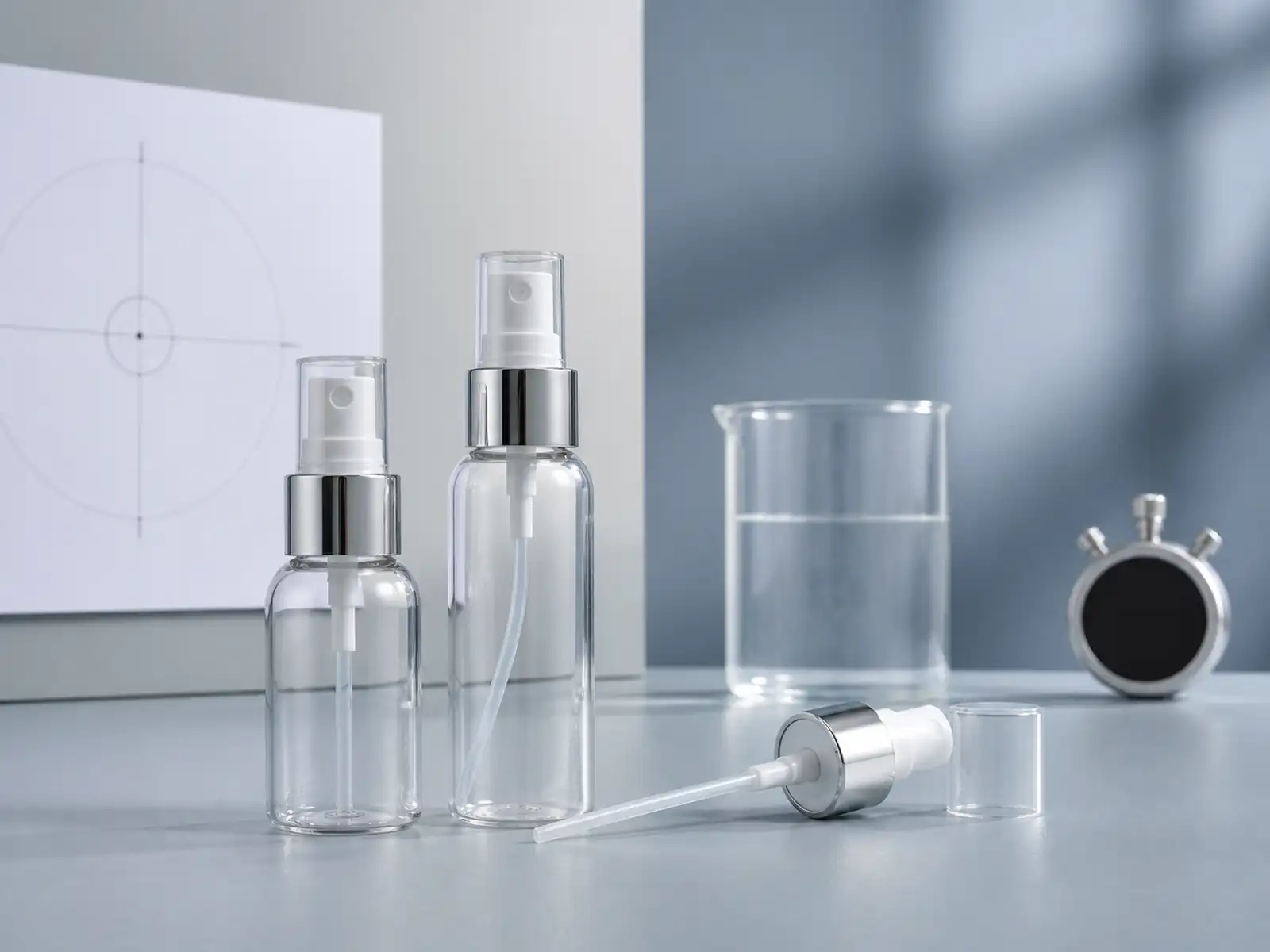
An attractive cloud in one demonstration is only the beginning of a fine-mist sprayer evaluation. A buyer also needs to know whether the complete bottle, pump, dip tube, closure and formula combination continues to dispense a controlled dose after storage, handling and repeated use. Instead of stopping at “Does this sprayer work?”, ask: “Under which defined conditions does this assembled system meet the project’s requirements, and what evidence will show that it still does?”
This distinction matters because four familiar observations—output, spray pattern, priming and clogging—describe different failure modes. A pump may deliver the correct mass per stroke while producing coarse droplets. It may create a good pattern once it is primed but require an unacceptable number of strokes after storage. It may pass with water and fail with the intended formula. Treating these observations as one generic “spray test” hides the cause of failure and makes supplier comparisons unreliable.
Start With the Use Case Before the Pump Specification
The test brief should begin with the way the customer will actually use the product. A facial mist, a hair product, a body spray and a fragrance may all use a mechanical sprayer, yet they can require different doses, plume shapes, droplet behavior and actuation force. The buyer should document the target area, expected application distance, number of strokes per use, package orientation, expected shelf life and likely storage temperatures.
The formula description must be specific enough for meaningful testing. Record viscosity at a stated temperature, density when output will be assessed by weight, alcohol or oil content where relevant, suspended particles, ingredients likely to dry at the nozzle, and any known foaming tendency. The purpose is a controlled technical handoff to the party responsible for testing, while the full proprietary formula can remain restricted. A surrogate liquid can support early screening, but final approval should be based on the intended formula or a technically justified representative with its limitations recorded.
Package configuration is equally important. State the bottle material and capacity, fill volume, neck finish, gasket or sealing element, dip-tube material and cut, actuator and nozzle, closure application conditions, and whether a protective cap or locking feature is used. A result from a loose component is not evidence for the assembled commercial system.
Convert Consumer Expectations Into Measurable Outputs
Buyers often begin with sensory language: “soft,” “wide,” “continuous,” “dry,” or “luxurious.” Those descriptions are useful, but an approval specification needs observable criteria. The development team should translate the experience into a combination of measured and visual outputs.
| Buyer expectation | Evidence that can support a decision | Important condition to record |
|---|---|---|
| Consistent dose | Mass or volume per stroke over a defined sequence | Formula density, stroke rate and actuator travel |
| Even coverage | Pattern image and defined evaluation zone | Distance, orientation, target surface and lighting |
| Quick first use | Number of full strokes to first acceptable discharge | Initial dry state, fill level and dip-tube position |
| No nozzle blockage | Successful restart after a defined rest or storage period | Formula, cap condition, temperature and elapsed time |
| Comfortable use | Peak actuation force and user observation | Actuator geometry and stroke speed |
| Stable through use | Results near full, mid and low fill levels | Orientation and remaining product level |
Each project needs acceptance limits drawn from its product experience, formula, selected dispenser and the risks the brand is prepared to accept. A supplier’s standard specification provides a useful starting point; the buyer still has to convert it into project requirements.
Test Output Across a Sequence of Strokes
Output is commonly reported as volume or mass per stroke. A single stroke is a weak measurement because pumps can behave differently during priming, after the system reaches steady state and as the fill level falls. A useful protocol separates those stages.
First, condition the specimens and formula at the defined temperature. Assemble and fill them using the intended process or a documented equivalent. Prime each unit according to the agreed method, then exclude priming strokes from steady-state output calculations unless the project explicitly needs total first-use delivery. Collect a defined number of full strokes at a controlled rhythm. Weighing the discharged product is often practical; conversion to volume requires a verified density at the relevant temperature.
Report individual results, the average and the spread. An average can conceal a pump that alternates between high and low output or one specimen that stops intermittently. Retain the sequence so reviewers can see drift. Repeat the measurement across more than one unit and, where the use case requires it, at full, mid and low fill levels.
ASTM Subcommittee F02.30 lists D4336 as an active practice for determination of output per stroke of a mechanical pump dispenser. Referencing the current controlled method can help teams use a common vocabulary, while the cosmetic project retains responsibility for its acceptance limit. The buyer must still define sample conditioning, formula, number of units, number of strokes and decision rule.
Make Spray-Pattern Images Comparable
Pattern assessment is often weakened by uncontrolled photographs. Changing the distance, background, lighting, stroke force or camera angle can make the same sprayer appear different. A useful pattern record fixes the setup.
Specify the target surface, actuator-to-target distance, package orientation, stroke technique, number of sprays and time between actuation and image capture. Keep lighting and camera position consistent. If the formula is transparent, a suitable indicator method may make coverage visible, but its effect on fluid properties must be considered. An ordinary photograph shows coverage rather than droplet-size distribution; a critical droplet-size requirement calls for specialized measurement.
ASTM F02.30 lists D4041/D4041M as the active practice for determining spray patterns of mechanical pump dispensers. The standard title supports a disciplined pattern method while leaving the preferred pattern to the application. A narrow plume may be desirable for a targeted product and unacceptable for a face mist.
Reviewers should look beyond overall width. Check for an off-center plume, a dense jet in the center, large peripheral droplets, intermittent spitting, asymmetry and change over repeated strokes. Record whether the pattern returns to normal after a pause. When samples are compared, randomize or blind the sample identity where practical so visual scoring stays independent of supplier or finish preferences.
Separate Priming From Restart Performance
Priming describes how the pump first draws product through the dip tube and pump chamber. Restart describes what happens after a filled, previously functioning pack rests for a defined period. They are related but not interchangeable.
For an initial priming test, define whether the unit begins dry, how it is filled, the orientation and what counts as a successful discharge. Treat a damp nozzle or a small bubble as a different outcome from a complete acceptable spray. Record every specimen, including any that never prime within the test limit. ASTM F02.30 lists D3890 as an active practice for the number of strokes to prime a mechanical pump dispenser; the project brief should identify the current edition actually used.
For restart assessment, prime and operate the system first, then store it under specified conditions. Record cap status, orientation, temperature and rest duration. On restart, count strokes to the first acceptable pattern and dose. Several rest intervals may be relevant: a normal daily pause, a longer consumer non-use period and a storage condition associated with distribution. These are project decisions, not universal industry intervals.
The distinction also guides corrective action. Poor first priming may point toward dip-tube fit, pump chamber filling, air leakage or assembly. Poor restart with acceptable initial priming may involve nozzle drying, volatile loss, formula deposition, seal behavior or loss of prime.
Design a Clogging Investigation That Preserves Evidence
Treat “clogged” as the start of the analysis. Before clearing or disassembling a failed nozzle, record the symptom. Did the actuator move normally? Was there no discharge, a reduced dose, a side jet, coarse droplets or product buildup? Was the failure temporary? Did it occur after a known number of strokes or after storage?
Keep a failed unit intact for visual examination. Photograph the nozzle and closure before cleaning. Compare its mass, dip-tube position and pump engagement with a functioning control. Check whether the formula has dried at the orifice, separated, crystallized or formed particles. Examine whether a cap was correctly seated. If disassembly is required, document the sequence so evidence is not confused with damage created during inspection.
Formula screening should include likely worst-case conditions, not only freshly filled room-temperature samples. Temperature cycling, extended rest, low fill, upright and allowed non-upright storage, and repeated use may be relevant. However, testing should simulate credible distribution and use rather than combining arbitrary extremes into a result that no real package would encounter.
Corrective options may include a different actuator or orifice, changes to the valve path, a protective cap, a modified formula-pump pairing, a different storage instruction or a controlled cleaning/restart design. Formula changes and regulatory decisions remain with the brand, supported by coordinated input from the packaging supplier and other responsible parties.
Use a Specimen Matrix That Can Reveal Variation
A credible validation set includes multiple assembled units and, when risk justifies it, more than one component lot. If decorated bottles are used, confirm whether decoration or curing could affect the neck, sealing surface or assembly. If samples are hand assembled while production will be machine filled and capped, record that difference.
A practical matrix may distinguish:
- baseline units tested immediately after filling;
- units stored at defined temperatures;
- units held for restart evaluation;
- units exercised through a defined number of strokes;
- units assessed at lower fill levels;
- reference units retained unopened;
- units from different component lots when supplier variation is a concern.
The matrix should identify destructive and non-destructive checks. Once opened for internal examination, a unit belongs to the destructive-inspection set rather than the untouched storage set. Unique specimen IDs prevent accidental mixing of results.
Diagnose Failures in a Fixed Order
When results are poor, changing several components at once may produce a working sample but teaches the team very little. Use a staged investigation.
- Confirm the symptom. Repeat the observation with the same specimen and controlled actuation.
- Check the test setup. Verify distance, stroke completion, scale, timing, formula temperature and specimen identity.
- Compare a control. Test an approved or previously stable configuration under the same conditions.
- Inspect assembly. Check closure engagement, dip-tube retention and cut, actuator seating and visible damage.
- Separate formula and hardware effects. Use a justified control liquid or alternative known system while preserving the intended formula test.
- Change one factor. Trial a single component or condition change and retain the original control.
- Repeat the relevant sequence. A one-time successful spray is not proof that the corrective action resolved storage or cycling behavior.
This approach turns a subjective complaint into evidence that a supplier, brand and test laboratory can discuss. It also reduces the risk of approving a revised sample that solved the visible symptom while introducing a different problem.
Build an Approval Record That Survives Reorders
The final report should identify the exact bottle, pump, actuator, dip tube, gasket and cap versions, along with formula or surrogate identity, fill volume, assembly process, dates, conditions and test methods. Include raw output sequences, pattern images with setup details, priming and restart results, abnormalities, deviations and the final disposition.
Link the report to approved drawings and a bill of materials. Retain physical reference samples where practical. If a pump, nozzle, dip tube, resin, spring or formula changes, use the record to decide which tests must be repeated. A result that cannot be tied to a component revision is difficult to use during a future complaint.
Approval language should be scoped. “Passed the agreed sprayer protocol using formula X and configuration Y under conditions Z” is more useful than “sprayer approved.” The first statement explains what the evidence covers. The second encourages reuse beyond the test boundary.
Questions to Resolve Before Issuing the Test Brief
- What consumer application and spray experience are required?
- Which formula and temperature will be used for final approval?
- What exact assembled component revisions are in scope?
- How will output, pattern and successful priming be defined?
- Which storage, restart, orientation and fill-level conditions are credible?
- How many units and component lots will be included?
- Which current ASTM or internal methods will be followed?
- Who owns raw data, deviations, corrective action and final approval?
- What change will trigger revalidation?
The value of a disciplined brief is visibility: it reveals performance early enough for the buyer to select, correct or reject a system before production commitments become expensive.
If you have a defined formula, bottle and target spray experience, send the project scope for a sprayer validation review. The response should confirm the test inputs and evidence path before any performance commitment is made.